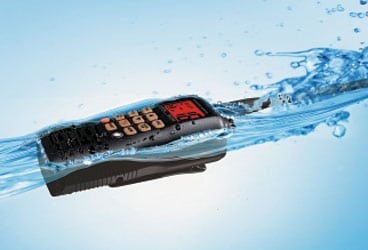
floating radio 368
A Radio at Home in the Water
Standard Horizon introduced an upgraded line of floating radios this year, and the company has improved upon the idea in various ways. Its basic floater is the HX750S, which can transmit at an impressive 6 watts, uses a Li-Ion battery that lasts 11 hours, and has programmable channel names, scan, dual-channel watch, and one-hand operation. The HX750S floats faceup, and when it hits the water, a strobe light mounted on its face starts blinking. Once recovered, the 750S even tells you the water temperature.
Next in the lineup is the HX760S, which has all the features of the HX750S but includes a wireless headset that communicates with the HX760S via Bluetooth 2, a wireless radio frequency. With the radio clipped to your belt and the headset attached to your ear, you can use either the push-to-talk mode or voice-activated transmission. This radio is ideal for people with only two hands and a lot to do, whether it’s
anchoring, docking, or steering in a big seaway.
The company’s third floater is the HX850S; in addition to being encased in rubber armor, it has a GPS receiver. The combination of GPS and VHF is ideal for taking advantage of digital selective calling, which is useful in distress situations. Both the HX750S and the HX850S have built-in jacks for remote microphones/speakers, and all three radios come with drop-
in cradles and chargers for both 110 volts AC and 12 volts DC.
HX750S ($150), HX760S ($630; less online), HX850S ($250); (714) 827-7600, www.standardhorizon.com
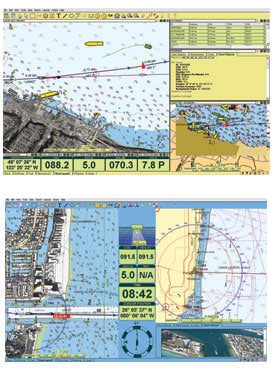
****| |C-Map’s new Max Pro charts and the NOAA S-57 ENC charts|
Navigation Software Gets Upgraded
NavSim, the maker of several different navigation-software packages, has announced that it now has the ability to use C-Map’s new Max Pro as well as NOAA’s S-57 ENC charts. The Max Pro charts offer NavRef photos to familiarize navigators with unfamiliar harbors as well as tide and current data, satellite imagery, Quick-Sync updating, and 3-D imagery. For an additional $50, NavSim users can add an auto-update feature for NOAA’s free S-57 ENC charts or Canada’s version, the CHS-57 charts, which require a subscription fee. Whenever your computer has Internet access, NavSim will automatically check your ENC chart library and see if NOAA has updated any of your charts. If it has, NavSim will download the updates automatically.
From $400, (709) 726-7779, www.navsim.com and www.cmapusa.com
An Array of New Screens Makes a Splash
****|
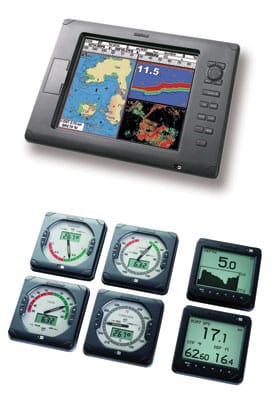
|The Simrad Nx40 NavStation and the Simrad IS20 instrument displays. |
Simrad electronics have long been standards of excellence aboard commercial vessels, and since Simrad was purchased by Navico, we’re starting to see more Simrad offerings for the recreational market. Two new plotters, the Simrad NX40 NavStation and the Simrad NX45 NavStation have, respectively, 8.4-inch and 12.1-inch daylight-visible displays that use C-Map Max charting. These multifunction displays are capable of displaying charts, radar, echo-sounder, camera, and engine data and have been designed with extremely intuitive keypad controls.
Simrad also has a new line of instrument displays, the Simrad IS20 range, which come in either digital or analog format, depending on the information displayed. For example, compass, rudder-angle, and wind-direction information is in analog format, which is easier for a busy helmsman to decipher. Speed, depth, water temperature, and similar information is displayed in digital format. These sensors are connected via the flexible Simrad data bus.
Simrad NX40 NavStation ($2,500), NX45 NavStation ($3,000), Simrad IS20 (starting at $450); (425) 712-1136, www.simrad.com
Prepare to Dive
****|
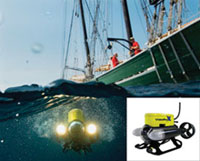
|VideoRay Underwater Robot|
Many of today’s megayacht owners are including small submarines as part of their fleet, and while they’re way cool, they’re expensive and too large for use with “normal” sailboats. That’s where the VideoRay Underwater Robot comes in. This small, 8-pound robot is controlled (and tethered) via cables and is maneuvered with a simple control panel. It carries a video camera that can show you the beauties of the deep or the ugly lobster-pot warp wrapped around your prop. Other accessories, such as positioning systems, still cameras, and even a grappling arm, are available as options.
Starting at $6,000, (800) 262-8464, www.westmarine.com
Offshore System’s Networked Tank Monitor
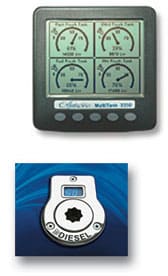
****| |Multitank Display and Fuel Deck Filler Gauge. | While NMEA 0183 remains in common use, NMEA 2000 exceeds that standard in its ability to both send and receive data for all the instruments linked to it.
Offshore Systems has developed an NMEA 2000-compliant tank-monitoring system that can show the status of all your vessel’s tanks on one display: black water, gray water, potable water, and fuel. The Multitank Display can represent as many as four tanks’ worth of data on analog gauges, as bar graphs, or as digital values.
The product I liked most is the company’s simple Fuel Deck Filler Gauge. Forget the days of watching the gauges down below while someone else is filling the tank or of crouching next to your fuel or water vent listening to the tank fill; the Offshore System’s filler cap sports a blue LED display that’s connected to the tank’s level sensor and shows you exactly how much liquid is in the tank.
If you’re not familiar with NMEA 2000, the simple explanation is that it’s an attempt by the National Marine Electronics Association to have all electronics manufacturers use a common, non-proprietary communications protocol to exchange data and provide power.
Multitank Display ($960), in-tank sensors (starting at $270), Fuel Deck Filler Gauge ($320), (949) 588-1470, www.oceanequipment.com
New Power in the Palm of Your Hand
****|
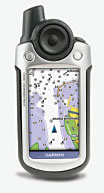
|The Colorado 400c|
Garmin’s latest color handheld GPS, the Colorado 400c, is a sophisticated, easy-to-use instrument that signifies a couple of big advances made by Garmin. The most obvious difference between the Colorado and other Garmin handhelds is an iPod-style wheel at the top of the device that, with two buttons, controls all the unit’s features. It’s the easiest one-hand-operated GPS I’ve ever used, and it has a large, bright (even in full sunlight) screen. The other noteworthy elements of the Colorado include a pre-loaded chart database of U.S. coastal waters and a USB cable computer interface that’s far better than the awkward serial-port converter required on older Garmin handhelds.
$700, (913) 397-8200, www.garmin.com
Go Wireless
****|
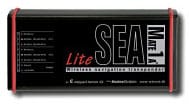
|SeaMate wireless router|
One of the bummers about the burgeoning array of electronics on any boat is the rat’s nest of wiring that comes with it. In Miami, I found an answer: the marine-quality SeaMate wireless router, which connects marine instruments with your boat’s computer via a wireless LAN. The router’s compatible with any instrument that sends data via NMEA 0183 (note: The router isn’t compatible with NMEA 2000) as well as AIS data. Although there’s only one NMEA port, it can be augmented with an NMEA multiplexer. This router is small, doesn’t use much juice, and can transmit signals up to 70 yards.
$700, (949) 588-1470, www.oceanequipment.com